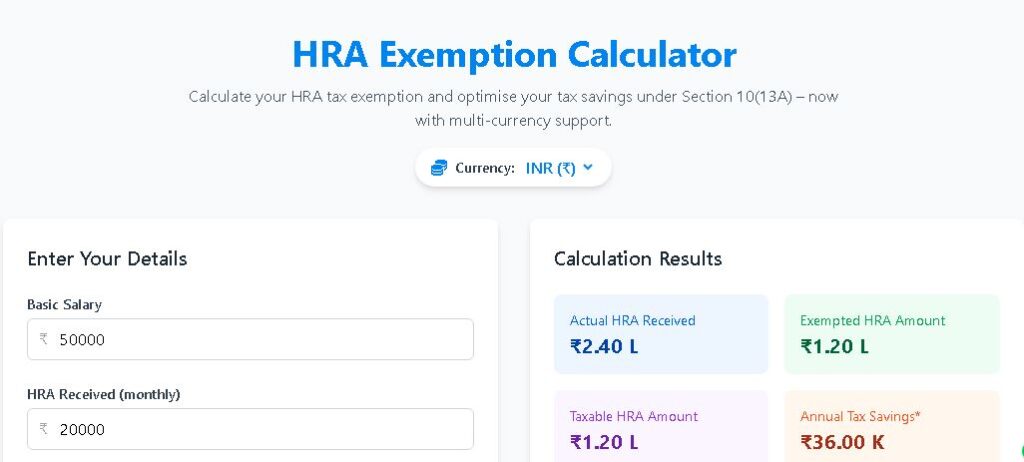
HRA Exemption Calculator
Calculate your HRA tax exemption and optimise your tax savings under Section 10(13A) – now with multi‑currency support.
Enter Your Details
How HRA Exemption is Calculated
The exempt amount is the least of the following:
- Actual HRA received
- 50% of salary (basic + DA) for metro cities, 40% for non‑metro
- Rent paid minus 10% of salary
Calculation Results
Enter your details and click “Calculate Exemption” to see your tax savings.
Actual HRA Received
₹0
Exempted HRA Amount
₹0
Taxable HRA Amount
₹0
Annual Tax Savings*
₹0
Calculation Breakdown
HRA Distribution
* Tax savings calculated at 30% tax rate. Actual savings may vary based on your income tax slab.
Tips to Maximise HRA Exemption
Rent Receipts
Always collect rent receipts from your landlord for proof of payment.
Rent Agreement
Have a formal rent agreement to validate your rental expenses.
PAN of Landlord
If rent exceeds ₹1,00,000 per year, provide landlord’s PAN to your employer.
Actual Payment
Pay rent through banking channels for easy tracking and proof.
📘 The Complete Guide to HRA Exemption – Formula, Rules & Tax Saving Strategies
House Rent Allowance (HRA) is one of the most valuable components of a salaried employee’s salary. It not only helps you meet your rental expenses but also offers significant tax savings. Under Section 10(13A) of the Income Tax Act, a portion of the HRA you receive from your employer can be exempt from tax, provided you actually pay rent for your accommodation. Understanding the rules and correctly computing the exempt amount can reduce your taxable income substantially. This guide explains everything you need to know about HRA exemption, complete with examples, documentation tips, and links to other reliable calculators you can use for verification.
How is HRA Exemption Calculated?
The tax‑exempt HRA is the minimum of the following three amounts:
- Actual HRA received from your employer during the financial year.
- 50% of your salary (basic salary + dearness allowance, if applicable) if you live in a metro city (Delhi, Mumbai, Kolkata, Chennai). For non‑metro cities, it is 40% of your salary.
- Actual rent paid minus 10% of your salary (basic + DA).
In mathematical form:
Exempt HRA = min( Actual HRA received , (metro? 50% : 40%) × Salary , Rent paid – 10% × Salary )
This calculator automatically applies these rules as you adjust the inputs. If you want to double‑check your results, you can also use the HRA exemption calculator on ClearTax which provides a detailed breakdown and tax saving tips.
Understanding the Key Terms
- Salary for HRA purposes: It typically includes your basic salary and dearness allowance (if it forms part of your retirement benefits). It does not include other allowances like LTA, medical, or special allowance. Our tool uses the basic salary you enter as a proxy.
- Metro vs. Non‑metro: Only the four specified cities are considered metro. Even if you live in a large city like Bengaluru or Hyderabad, you must use the non‑metro rate of 40%.
- Rent paid: This must be the actual rent you pay to your landlord. If you share accommodation, only your portion of the rent can be claimed.
A Detailed Working Example
Let us say your monthly basic salary is ₹60,000, HRA received is ₹24,000, and you pay ₹18,000 as rent in Mumbai (metro). For the full financial year:
- Annual HRA = ₹24,000 × 12 = ₹2,88,000
- 50% of salary = 0.5 × (₹60,000 × 12) = ₹3,60,000
- Rent minus 10% of salary = (₹18,000 × 12) – (0.1 × ₹7,20,000) = ₹2,16,000 – ₹72,000 = ₹1,44,000
The least of these three is ₹1,44,000, so that is the exempt HRA. The remaining ₹1,44,000 (₹2,88,000 – ₹1,44,000) is taxable. If you fall in the 30% tax bracket, you could save approximately ₹43,200 in tax. Tools like the Groww HRA calculator let you run similar scenarios and see how different rent amounts affect your tax liability.
When Do You Need Landlord’s PAN?
If your annual rent exceeds ₹1,00,000 (i.e., more than ₹8,333 per month), you must provide the PAN of your landlord to your employer. If the landlord does not have a PAN, they must submit a self‑declaration in Form 60. Failing to do so can lead to the HRA exemption being disallowed or limited. For more specific cases, the ICICI Prudential HRA exemption calculator can help you understand the impact of rent thresholds.
Documents Required to Claim HRA
To claim HRA exemption, you should maintain the following documents:
- Rent receipts: Dated receipts from your landlord for every payment. If the rent exceeds ₹1,00,000 per year, the receipts must include the landlord’s PAN.
- Rent agreement: A formal leave and licence agreement or rental deed is highly recommended, even though it is not always mandated by the Income Tax Department.
- Proof of payment: Bank statements showing rent transfers are the best evidence. Avoid paying rent in cash above ₹2,00,000 per month, as this can attract penalty provisions.
Can You Claim HRA if You Live in Your Parents’ House?
Yes, you can pay rent to your parents and claim HRA exemption, provided they own the house and declare the rental income in their tax return. The rent agreement should be legitimate, and payments should be made through banking channels. This is a common but legally valid tax‑planning strategy. To see how much you could save, try the Finnovate HRA calculator which offers a simple interface for such scenarios.
HRA and Home Loan – Can You Claim Both?
If you are paying both rent and home loan EMIs for a property in a different city, you may claim HRA exemption for the rented house and also claim deductions for home loan interest under Section 24 and principal repayment under Section 80C. However, if you own a house in the same city where you work and live, you cannot claim HRA unless you can prove that the owned house is not suitable for your occupation (e.g., it is far from your workplace). The Shriram Finance HRA calculator can help you quantify the combined benefit in such dual situations.
Common Mistakes That Reduce Your Exemption
- Not submitting rent receipts on time: Your employer requires them for tax computation. Late submission can lead to higher TDS.
- Ignoring the metro/non‑metro distinction: Using 50% when you live in a non‑metro city will lead to an incorrect claim and possible scrutiny.
- Paying rent to a spouse: This is generally not allowed because it may be seen as a sham transaction. The relationship must be at arm’s length.
- Assuming full HRA is exempt: Only the least of the three components is exempt; the balance is fully taxable.
How This Multi‑Currency HRA Calculator Helps
Our calculator instantly computes the exempt and taxable HRA as you adjust the salary, HRA, rent, and city status. The currency selector (₹, $, €, £, ¥) makes it convenient for NRIs or expatriates who want to estimate their exemption in a familiar symbol. The doughnut chart visualises the split between exempt and taxable HRA, while the breakdown panel shows the three components at a glance. Use it alongside other trusted platforms like ClearTax or Groww to be doubly sure of your numbers.
Tax Planning with HRA
To maximise your savings, ensure that your salary structure is optimised. If you have the flexibility, allocate a higher amount to HRA (within reasonable limits) and pay an actual rent that pushes the third component lower. However, always ensure that the rent paid is justifiable and supported by documentation. For additional tax‑saving ideas, the ICICI Prudential calculator and Finnovate can help you simulate different salary‑rent combinations.
Frequently Asked Questions
Q: Can I claim HRA if I am self‑employed?
No, HRA exemption under Section 10(13A) is available only to salaried individuals who receive HRA as part of their salary. Self‑employed individuals can claim rent paid under Section 80GG, subject to different conditions.
Q: Is there a limit on the rent I can pay to claim HRA?
There is no specific upper limit on rent, but the exemption is capped by the three‑way minimum rule. Paying extremely high rent relative to your salary may not proportionally increase the exemption.
Q: What happens if I forget to submit rent receipts to my employer?
You can claim the exemption when filing your income tax return (ITR) by showing the exempt amount under “Salary” and providing the details. However, you will have to wait for the refund if excess TDS was deducted.
Final Thoughts
HRA exemption is a powerful tax‑saving tool that can reduce your taxable income by several lakhs every year. By understanding the formula and keeping your documentation in order, you can make the most of this benefit. Our calculator gives you a quick, accurate estimate, and you can always cross‑reference with other trusted resources like the Shriram Finance HRA calculator to ensure consistency. Remember to review your tax plan at the start of each financial year and adjust your rent payments and declarations accordingly.
⚠️ Important Disclaimer
This calculator provides estimates for educational and planning purposes only. Actual HRA exemption may vary based on your exact salary components, rent receipts, and tax laws. Always consult a qualified tax professional for official calculations. Finance Toolbajar is not liable for any financial decisions made using this tool. The external links provided are for additional reference and do not imply endorsement.