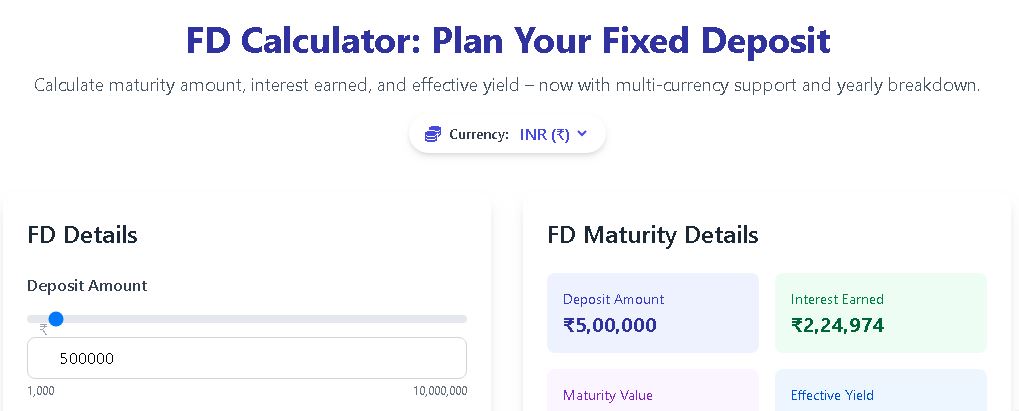
FD Calculator: Plan Your Fixed Deposit
Calculate maturity amount, interest earned, and effective yield – now with multi‑currency support and yearly breakdown.
FD Details
About Fixed Deposits
Fixed Deposits (FDs) are investment instruments offered by banks and NBFCs where you can deposit a lump sum amount for a fixed tenure at a predetermined interest rate. They offer guaranteed returns and are considered low-risk investments.
FD Maturity Details
Deposit Amount
₹5,00,000
Interest Earned
₹2,24,364
Maturity Value
₹7,24,364
Effective Yield
7.5%
Yearly Breakdown
| Year | Opening Balance | Interest | Closing Balance |
|---|
📘 Fixed Deposit: Complete Guide & Formula
A Fixed Deposit (FD), also known as a term deposit, is one of the most popular investment instruments in many countries, especially in India. It allows you to invest a lump sum amount for a fixed period at a predetermined interest rate, earning guaranteed returns. In this comprehensive guide, we’ll cover how FD maturity is calculated, the impact of compounding frequency, tax implications, and how our multi‑currency calculator can help you plan better. We’ll also share links to trusted FD calculators from banks and financial platforms so you can cross‑verify your results.
🔢 The FD Formula (Compound Interest)
For cumulative FDs where interest is reinvested, the maturity amount is calculated using the compound interest formula:
- A = Maturity amount
- P = Principal (deposit amount)
- r = Annual interest rate (decimal)
- n = Number of compounding periods per year (e.g., 4 for quarterly)
- t = Tenure in years
For non‑cumulative FDs (interest paid out periodically), simple interest is applied: Interest = P × r × t. The principal remains constant, and the payout does not earn further interest.
📊 Example Calculation (Quarterly Compounding)
Suppose you deposit ₹5,00,000 at 7.5% p.a. for 5 years, compounded quarterly (n=4). Using the formula:
A = 5,00,000 × (1 + 0.075/4)4×5 = 5,00,000 × (1.01875)20 ≈ ₹7,24,364
Interest Earned = ₹7,24,364 – ₹5,00,000 = ₹2,24,364
Our calculator above does this instantly for any tenure, payout option, and currency. Try changing the payout frequency to see the effect.
⚖️ Cumulative vs. Non‑Cumulative FDs
- Cumulative FD: Interest is reinvested and paid at maturity. Best for wealth accumulation.
- Non‑Cumulative FD: Interest is paid out periodically (monthly, quarterly, etc.). Suitable for regular income needs (e.g., retirees).
💡 Factors Affecting FD Returns
- Compounding frequency: More frequent compounding (quarterly vs. yearly) yields higher returns.
- Tenure: Longer tenures allow more compounding cycles, increasing effective yield.
- Interest rate: Usually, senior citizens get a higher rate (often 0.25%–0.75% extra).
- Tax deduction at source (TDS): In India, banks deduct TDS on interest exceeding ₹40,000 (₹50,000 for senior citizens) per annum. Plan accordingly.
💰 Tax on Fixed Deposit Interest
Interest earned from FDs is fully taxable as per your income tax slab. Banks deduct TDS at 10% (if PAN is provided) or 20% (without PAN) if interest exceeds the threshold. You can submit Form 15G/15H to avoid TDS if your total income is below the taxable limit. For NRIs, TDS is applicable at a higher rate. Always consult a tax advisor.
📈 FD vs. Recurring Deposit (RD) vs. Mutual Funds
- FD: Lump sum investment, fixed return, low risk.
- RD: Monthly investments, also fixed return, ideal for regular savers.
- Debt mutual funds: Market linked, higher potential returns but with some risk.
- Use our SIP calculator to compare with mutual fund investments.
🌍 Multi‑currency FD Calculator – How It Works
The calculator at the top lets you choose from INR, USD, EUR, GBP, and JPY. Simply select your currency, and all amounts (deposit, interest, maturity) will display with the corresponding symbol. This is particularly useful for NRIs comparing FD rates in different countries or for international investors. Note: No actual currency conversion is applied; it simply changes the symbol.
🔍 Frequently Asked Questions
Q: What is the minimum tenure for an FD?
Banks offer FD tenures ranging from 7 days to 10 years. Some NBFCs may offer up to 20 years.
Q: Can I withdraw my FD before maturity?
Yes, most FDs allow premature withdrawal, but a penalty (usually 0.5%–1%) may apply.
Q: What is the difference between FD and RD?
FD requires a one-time lump sum; RD requires monthly investments. Both offer fixed returns.
Q: How is FD interest calculated for senior citizens?
Senior citizens usually get an additional 0.25%–0.75% interest. Use the calculator with the higher rate.
Q: Is FD interest compounded monthly or quarterly?
In India, most banks compound interest quarterly, though some may offer monthly compounding for specific schemes.
📚 Popular FD Calculators from Banks & Financial Platforms
To ensure you’re getting an accurate picture, it’s wise to compare results across multiple trusted sources. Here are some excellent fixed deposit calculators you can use alongside ours:
- Groww FD Calculator – A sleek, intuitive fd calculator that also shows the effect of taxation.
- ICICI Bank Fixed Deposit Calculator – From one of India’s largest banks, ideal for checking ICICI FD rates and maturity.
- Kotak Mahindra Bank FD Calculator – A detailed fixed deposit calculator with options for senior citizens and NRI deposits.
- IndusInd Bank FD Calculator – Provides quick maturity estimates for IndusInd fixed deposits.
- NISM FD Calculator – A research‑backed FD interest calculator maintained by the National Institute of Securities Markets.
- Bajaj Finserv FD Calculator – Helps you calculate returns on Bajaj Finance FDs, known for higher rates.
Using multiple calculators gives you confidence in the numbers and helps you spot any discrepancies. Always verify with your financial institution before locking in an investment.
🏦 Types of Fixed Deposits You Should Know
Beyond standard FDs, banks offer several variants to meet different needs:
- Tax‑Saver FD: A 5‑year lock‑in FD that qualifies for tax deduction under Section 80C of the Income Tax Act. The deposited amount (up to ₹1.5 lakh) can be deducted from your taxable income.
- Senior Citizen FD: Additional interest rate (usually 0.25%–0.75% higher) for individuals aged 60 and above.
- NRI Fixed Deposits: Non‑Resident External (NRE) and Non‑Resident Ordinary (NRO) accounts allow NRIs to hold foreign currency deposits with repatriation benefits.
- Flexi Fixed Deposit: Combines the features of a savings account and an FD. Your idle savings automatically sweep into a higher‑interest FD, yet you can withdraw without breaking the entire deposit.
- Corporate Fixed Deposits: Offered by NBFCs and companies; typically offer higher interest rates but carry slightly higher risk compared to bank FDs.
📅 FD Laddering Strategy for Better Liquidity
Instead of locking all your money in one FD, you can split it across multiple FDs with different maturities. For example, divide ₹10 lakh into five FDs of ₹2 lakh each, maturing in 1, 2, 3, 4, and 5 years. As each FD matures, you can either reinvest it (perhaps at a higher rate) or use the funds. This strategy, known as FD laddering, provides regular liquidity and reduces reinvestment risk.
📉 Impact of Inflation on Fixed Deposit Returns
While FDs are safe, inflation can erode your real returns. If the FD offers 7% and inflation is 5%, your real rate of return is only 2%. Use our calculator to see the nominal maturity value, then consider inflation to gauge purchasing power. This is why many investors combine FDs with higher‑yielding instruments like mutual funds to beat inflation over the long term.
📊 Interpreting the Yearly Breakdown
The table on the results side shows how your balance grows each year. For cumulative FDs, you’ll notice the interest earned increases each year due to compounding. This exponential growth is the beauty of compound interest – the longer you stay invested, the faster your money grows. For non‑cumulative FDs, the annual interest remains constant.
🔗 Related Tools from Finance Toolbajar
- CAGR Calculator – For lump sum investment returns.
- SIP Calculator – Plan mutual fund investments.
- Percentage Calculator – Quick percentage changes.
- RD Calculator – For recurring deposits.
Long‑tail keywords you may have searched: “fixed deposit calculator with quarterly compounding”, “fd vs rd which is better”, “tax on fd interest for senior citizens”, “how to calculate fd maturity amount in excel”, “best fd rates for nri”, “cumulative vs non cumulative fd calculator”.
⚠️ Disclaimer
This calculator provides estimates based on the inputs provided. Actual returns may vary due to changes in interest rates, tax deductions, or bank policies. Always verify with your financial institution before making investment decisions. Finance Toolbajar is not liable for any losses or discrepancies.
© 2025 Finance Toolbajar. All rights reserved.